
Self-Centering Vises Are Popular Because They Simplify Symmetry
Hydraulic vise reduce the time spent nudging parts into position because the jaws move symmetrically. For many part families—especially symmetric blanks—this improves speed and consistency. But “self-centering” doesn’t automatically mean “right for every material and cutting style.”
The fastest way to choose correctly is to focus on two things:
- repeatable positioning accuracy, and
- whether the vise is intended for steel/hard materials.
H54: Affordable, System-Compatible, Best for Softer Materials
Xindian describes the H54 self-centering vise as an affordable product designed for compatibility with EROWA and SYSTEM 3R zero-point positioning systems. It provides multiple jaw options and states repeatable positioning accuracy can reach 0.03 mm. The listing also clearly notes it’s mainly suitable for soft materials and is not recommended for steel parts.
This makes H54 a smart choice when:
- you mostly machine aluminum, plastics, and softer alloys,
- you want a cost-effective entry into repeatable workflows,
- your tolerances and process can live comfortably with 0.03mm repeatability.
It’s also practical that the listing calls out jaw variety (serrated, extended serrated, high serrated, and special-shaped soft jaw options). That flexibility often matters more than people expect, because jaws define how well the vise adapts to different workpieces.
H67 and H90X: Precision + Hardness for Steel and Heavy Cutting
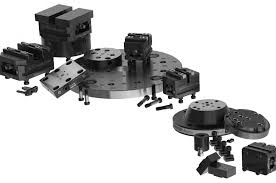
For harder work, Xindian’s descriptions for H67 and H90X emphasize:
- the vise is precision ground in all directions and performs well in parallelism/perpendicularity,
- repeatable positioning accuracy reaches 0.02 mm,
- material is alloy steel, and after heat treatment hardness can reach HRC58–62,
- the vise supports processing hard materials such as steel,
- jaw options include 60° serrated dovetail jaws and special-shaped soft jaws.
If steel is a regular part of your workload, those statements matter because steel cutting amplifies instability:
- higher cutting forces,
- more vibration potential,
- more visible consequences from micro-movement at the clamp.
Hardness and precision grinding aren’t marketing features—they’re indicators of whether the 5th axis vise is intended to hold geometry and resist wear across repeated cycles.
Does 0.01mm (0.03 → 0.02) Really Matter?
For one-off parts, maybe not. But for repeatable workflows—especially second ops and “stop-and-resume” scheduling—repeatability becomes a time saver. The difference shows up as:
- fewer re-indicating steps when jobs return,
- less adjustment when the same fixture comes back onto a machine,
- better consistency across operators.
If your production reality is “frequent repeats,” repeatability is a productivity tool—not just a quality spec.
A Simple Decision Model
Choose H54 when:
- you primarily cut soft materials,
- you want EROWA/3R-style compatibility,
- 0.03mm repeatability fits your process,
- you value broad jaw options for flexible work.
Choose H67 or H90X when:
- you need the vise to support steel/hard materials,
- you want 0.02mm repeatability,
- you want alloy steel with heat-treated hardness (HRC58–62) and precision grinding characteristics described for higher stability. Xindian CNC+1
Bottom Line
H54 is positioned as an affordable, EROWA/3R-compatible vise with 0.03mm repeatable positioning and a clear recommendation toward soft materials. H67 and H90X are described with 0.02mm repeatability, alloy steel heat treatment to HRC58–62, and suitability for steel, plus 60° serrated dovetail jaw options.